
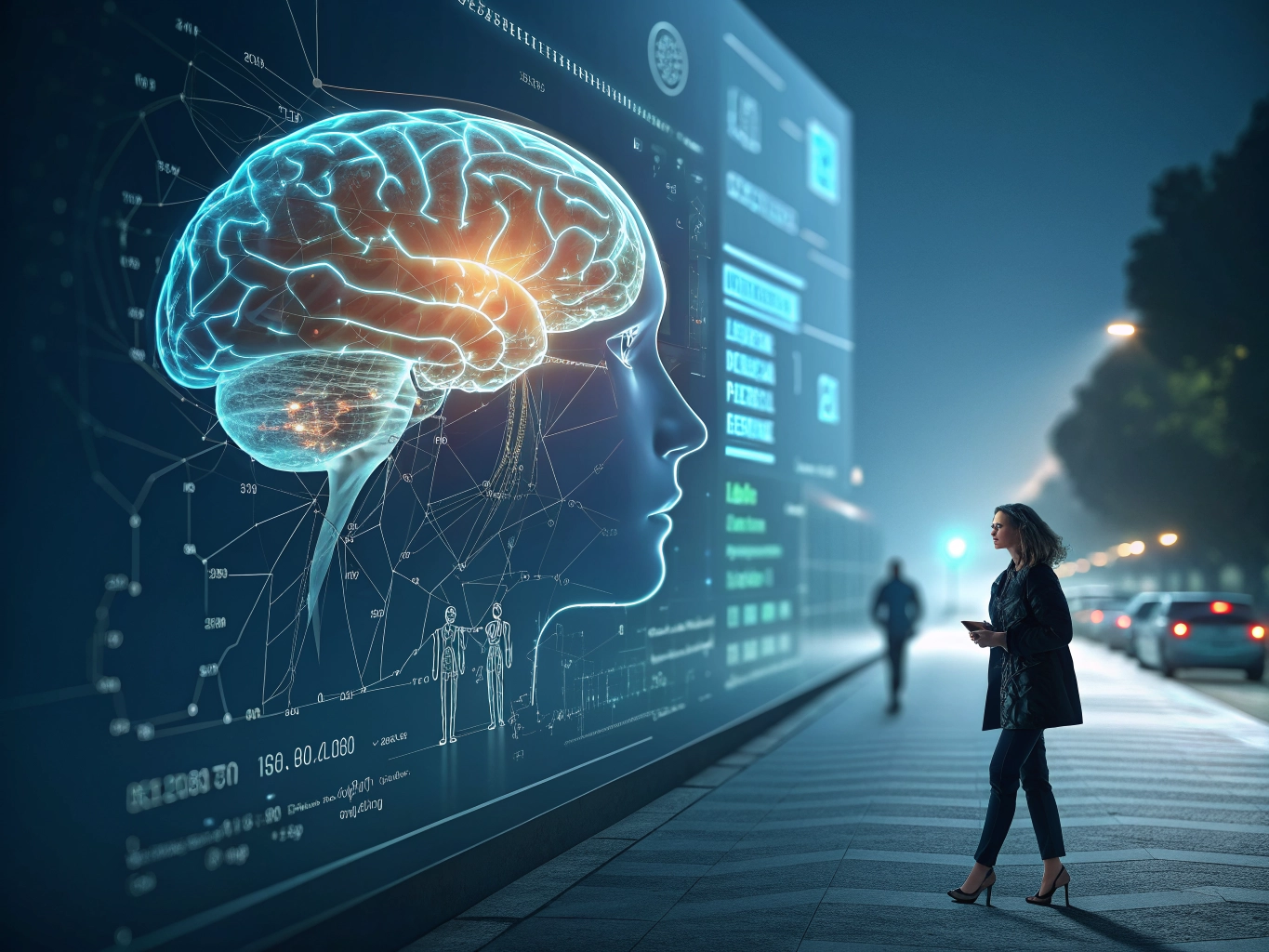
We are not afraid of machines reading our minds, but rather who accesses that data. Something considered to be merely science fiction is now becoming reality. Some innovations of modern science were believed to be beyond human reach. BCI is one of those innovations. These systems can link the human brain to external devices such as computers and robotic limbs. A person can command technology using thoughts alone. BCIs are developing rapidly through advances in neuroscience, artificial intelligence, and engineering. You start to notice the real risk when you take a closer look at BCI. Along with the advantages they bring, they do raise serious issues of mental privacy, individual control, and human interaction with technology in the future.
Neurons communicate through tiny electrical signals that can be measured using sensors and processed by BCIs. BCIs are either invasive or non-invasive. Non-invasive BCIs such as Electroencephalography (EEG) headsets are placed outside the body, usually on the scalp. Invasive BCIs need to be implanted inside the brain for more accurate signal detection. The two differ in accuracy by a huge margin. Non-invasive BCIs are low-risk but less accurate because the skull and other tissues interfere with the signal. On the other hand, invasive BCIs are high-risk because of medical risks and device failures. The use of AI to translate the signals to commands is extremely effective, as AI improves processing time. Success has been seen when paralyzed people who could not speak communicated through BCI systems using their thoughts. BCIs have also been used to control robotic limbs that function by responding to the user’s neural activity and are highly accurate, enabling precise movements.
Medicine is progressing, and its cause is BCI. The disabled and paralysed can regain communication and movement. Patients with conditions such as spinal cord injuries or stroke may use BCIs to control wheelchairs, prosthetic limbs, and even speech-generating devices. For this reason alone, BCIs bring a revolutionary change in the field of medicine. Beyond healthcare, BCIs can entirely change the way humans interact with technology. One day, people may use their thoughts to control smartphones and drive vehicles. Education may benefit from BCIs by making learning more personalised. Learning patterns can be detected and then used to customise lessons for better understanding. These possibilities suggest a future where technology becomes faster, more natural, and deeply connected to the human brain.
As always, a negative side exists. They bring a major ethical challenge. Brain signals reveal emotions, preferences, intentions, and health conditions. Our mental privacy and freedom will be threatened if our brain data is accessed by others. Governments and companies may misuse our brain data to manipulate us. Cases of data being misused or used to blackmail already happen online. What is our brain becoming the new medium for it to take place in? Thoughts are more private than fingerprints and passwords. If others can access our thoughts and intentions, then misuse of brain data can become a serious violation of human rights.
Autonomy and individual control are equally important. Imagine not knowing whether your actions are truly yours. Nothing is perfect; machines make errors and could also end up getting hacked or influencing decisions. Questions on consent arise for the people on whom experimental devices are tested. Affordability is another factor that cannot be ignored. An enormous part of society would not be able to afford it, furthering the division between the rich and poor. BCIs may become a luxury item rather than something that is beneficial to all. This will lead to the wealthy having a significant advantage over the poor. The one last point that should be looked at is the physiological and philosophical issues. If technology becomes powerful enough to alter an individual’s memory and emotions, then what does it mean to remain fully human? Humans may lose authority over themselves and be controlled by technology. A society needs to decide for itself whether BCIs should be used for everyday tasks or strictly for medicine.
The real danger isn’t machines thinking like us, but that we may stop questioning who they think for. Brain-computer interfaces have the potential to revolutionize medicine and
human-computer interactions. However, it does have many potential dangers. They may be capable of restoring movements and improving communication, but also of invading mental privacy, reducing autonomy, and widening social inequality. Before BCIs are actually implemented on a large scale commercially, legal and ethical opinions should be taken into consideration. Humanity must put a limit on the advancement of technology. The real question is not technology. Control is.