
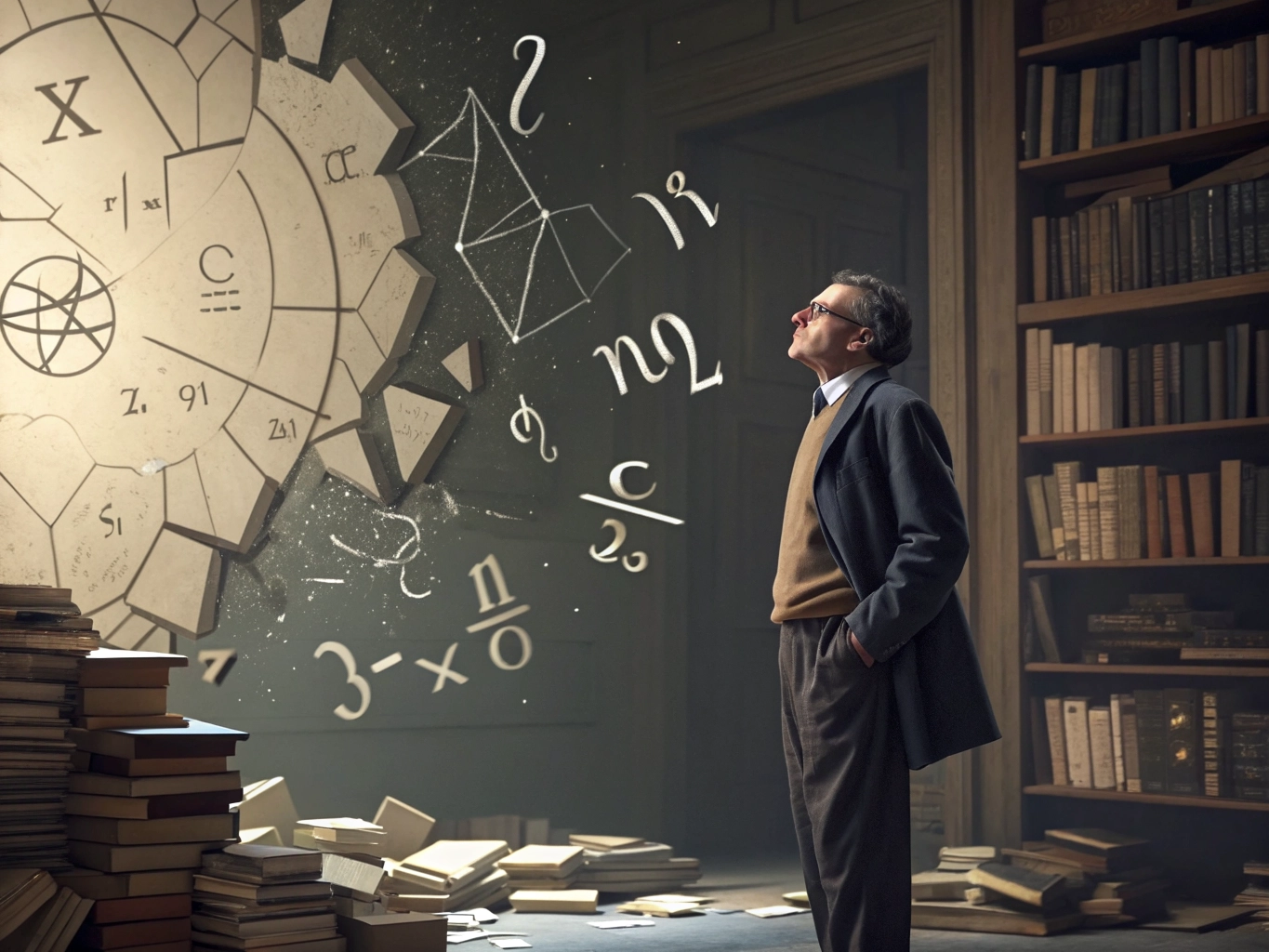
In 1931, a 25-year-old Australian published something no one understood at first. A silent paper containing two theorems backed up by dense logic. After mathematicians read it, they were left speechless. Something that could not be taken back had been revealed to the entire world. The belief that maths is perfect was proved to be an illusion. David Hilbert had proposed that mathematics was an area that could achieve perfection. He was widely regarded as the greatest mathematician of the 20th century. All accepted Hilbert’s Programme, and hence the two theorems published by Kurt Gödel came as a shock. The problem that arose was not that humankind wasn’t clever enough to achieve something to be perfect and complete, but the fact that it was mathematically self-defeating.
We must understand what was believed before understanding how it broke. David Hilbert’s dream was to create the perfect mathematical system. Something that would remain the same throughout the universe, a desire for maths to be eternal. Kurt Gödel said that maths cannot prove everything within it without an external greater source. This concept can be understood better with an example. Imagine you are in a village where everybody can speak either only lies or only the truth. You are then approached by a villager who says a simple sentence: “I am not a liar.” Now think carefully, if he is honest, then he is a liar, which is a contradiction. If he is a liar, then the statement is false, meaning he is honest, which again is a contradiction. This is also the case in maths. This did not break maths as theorems still get proved. What it did break is the belief that truth and proof are the same. Truth is something maths cannot fully reach.
Now, let’s look at the actual theorem in simple words. It is an interesting theorem that looks complicated at first glance. “The first theorem is that any consistent system F, within which a certain amount of arithmetic can be carried out, is incomplete.“ This states that there are a few statements of language F that cannot be proven or disproven in F. There is one specific statement to look at here:” This statement has no proof.” Maths now had no way out. If the statement could be proven, then it was wrong, as something false was proved. If the statement could not be proven, then the statement is true, and maths could not prove it. Both cases lead to bad endings. This simply explains to us that Hilbert’s perfect rulebook was left incomplete because it was not achievable.
There is one more example that further explains this concept. Imagine a newspaper that makes a statement that says it covers every story in the world. A man then asks whether the newspaper has covered the story of their own promise. If the editor writes about their latest story, a new story is created that has not yet been covered in the newspaper. This creates a loop. A new story will always be created that would not have been already written. This means that the newspaper will never be complete and will forever chase its own story. The newspaper isn’t incomplete due to laziness, but because it is impossible. This is the exact situation with Hilbert’s promise. The one flaw that cannot be fixed.
We must understand that Gödel did not break maths; he revealed its true nature. Math remains extremely precise and useful, just not flawless. Hilbert’s dream paved the path for mankind to understand that some truths lie beyond proof. Maths had never been closer to perfection when it discovered something shocking: it could not prove itself.