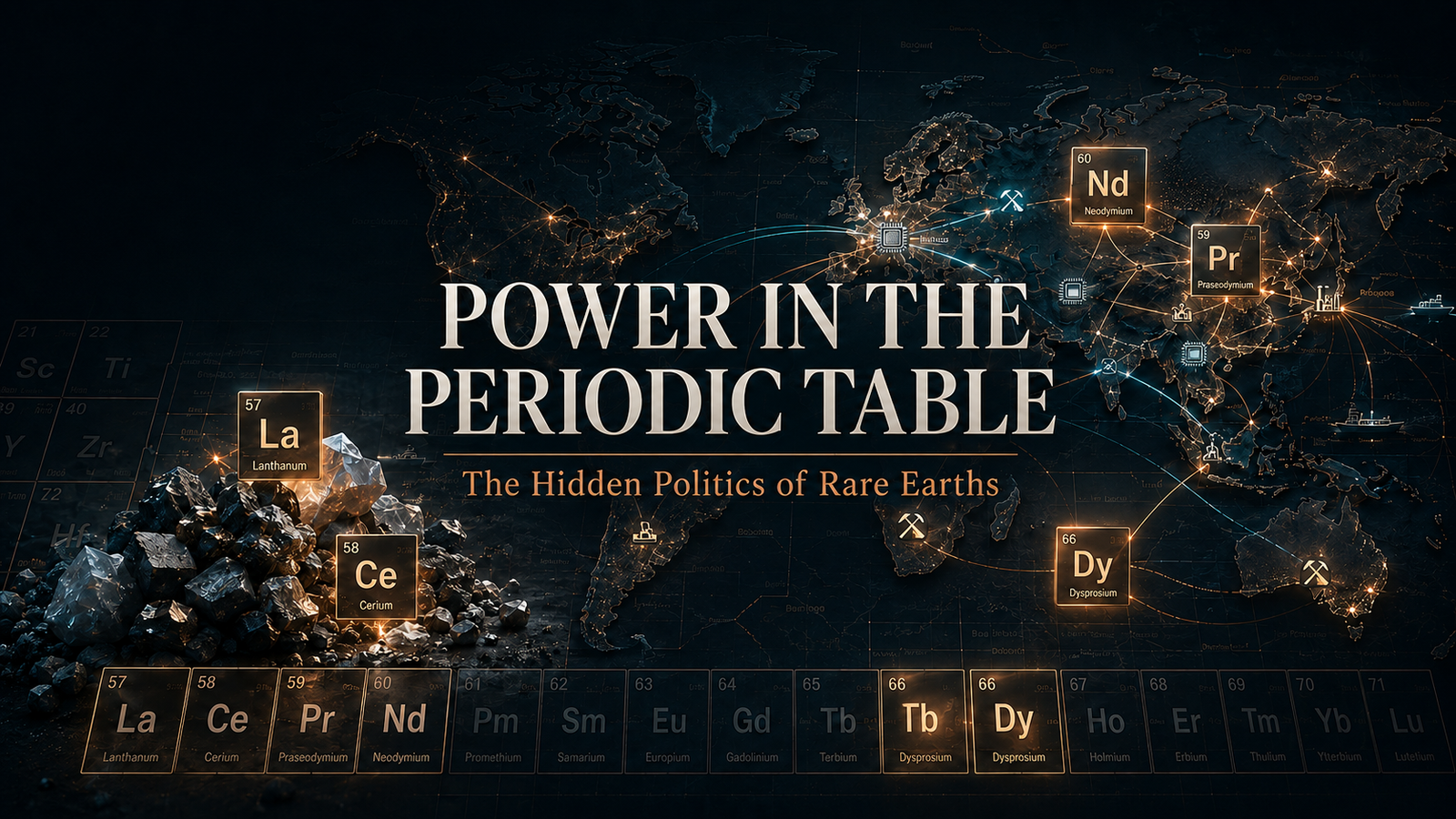
Among the many wars being fought today, one never makes the headlines. No troops are deployed, and no missiles are fired. Its weapons are quieter. The world today is increasingly technology-driven, where even the elements of the periodic table depict the political power of a nation. The rare earth elements are a group of 17 elements that sit in the lower rows of the periodic table, invisible to the lives they govern. They do not make the headlines, but instead shape what makes the headlines. They are essential for modern technology, powering systems such as electric vehicles, wind turbines, smartphones, medical imaging systems, and advanced military equipment.
Despite their name, they are not rare. These elements, including neodymium, dysprosium, and lanthanum, are abundant in the Earth’s crust. Cerium, a rare earth element, is more common in the Earth’s crust than copper. However, they are difficult and costly to extract and refine into usable forms. As demand for these elements continues to rise, control over their supply has become a significant influence on geopolitical power, a fact which often goes unnoticed. The country that controls its supply can exercise power over dependent nations without firing a single shot.
Rare earth elements are a set of 17 similar elements that have unique properties like being magnetic, luminescent, and electromagnetic. These are the foundations of modern technology. Neodymium and praseodymium are needed to create strong magnets used in electric vehicles and wind turbines. Dysprosium and samarium are heat-resistant magnets used in defence systems and aerospace applications. For smartphone screens, TVs, and LED lights, europium and terbium are crucial as they are luminescent. These examples highlight the importance of such materials. With no effective substitutes, without them, modern technology would be less efficient or could even cease to exist. A nation relies heavily on these elements for modern defence systems and military strength.
This is where the political significance becomes clearer as there is a difference in mining and processing them. Rare-earth elements play an important role in the transition to clean energy. They enable the more efficient development of clean energy technology. Mining is difficult and environmentally challenging. They are found in abundance in various parts of the world, like Australia, the United States, India, Brazil, Russia, and across sub-Saharan Africa. However, they cannot be processed in all regions. To convert raw ore into usable industrial material, a chemical separation of extraordinary precision is required. A single country overwhelmingly controls the ability to process these elements: China. Because of this, most countries are dependent on China, as processed materials are needed for technology, energy, and defence systems. There is a huge contrast between the availability of the raw elements and the concentration of processing capacities. This imbalance in the supply of rare earth elements gives China the power to influence other nations through political strategies. China showed its power in 2010 in a dispute with Japan over the Senkaku Islands. China reduced its rare earth exports to Japan, which led to sudden price increases and disruptions in Japanese industries and the global market. The restrictions on Japan were temporary, yet the global effects were immediate. After this event, Japan made a politically strategic choice to avoid being dependent entirely on one country. Japan reduced its dependency on China from 90% in 2010 to 60% today. This shows that a country is vulnerable if it is dependent on something that it does not control. China understood this earlier than other nations and invested accordingly, now having a noticeably large gap in its processing capacity in comparison to other nations. China currently controls approximately 90% of the world’s total processing and refining capacity for these resources.
Rare earths are not merely materials but sources of power. Their demand will continue to increase as more countries are trying to shift to using clean energy. These materials are a necessity for clean energy, and the competition for processing and mining them is becoming more intense. Many countries that manufacture electric vehicles, superconductors, or smartphones remain dependent on China. Oil shaped global power in the twentieth century; rare earths are doing the same in the twenty-first. Many nations are now trying to invest in new mining projects and processing plants to decrease dependency on imports. However, these efforts take time, and China continues to be a bottleneck in the supply chain. Countries like the United States, the European Union, and Australia are aiming to increase their processing capacity. The US spent over $1 Billion just on rare earths, along with partnerships with private firms. It also reopened the Mountain Pass mine that had been closed in 2015. The EU is targeting to go from having 10% to having 40% of its rare earths supplies processed in the EU itself. It introduced the Critical Raw Minerals Act and is trying to recycle the rare earths, along with diversifying its supply sources. The EU wants strategic autonomy, which means reducing reliance on external powers like China. Finally, Australia currently produces around 15% of the global rare earth supply. It is expanding its mining operations and creating more processing plants. Australia is also partnering with the US. The most powerful nations may not be the ones with the strongest armies, but those with control over what the world cannot function without.