
Most of us do not fully grasp what infinity actually means. Imagine something that is fully occupied yet able to make space for more. Infinity behaves in a way that no finite number can. Hilbert’s Hotel is a famous thought experiment that was introduced by David Hilbert to show the capabilities that infinity possesses. I want you to picture a hotel that has an infinite number of rooms and an infinite number of guests, each occupying one room. A bus arrives at the hotel with an infinite number of people, each wanting a room to check into. Your only choice in a hotel with finite rooms would be to turn them away, but in this scenario, you can ask each guest to move from room N to room 2N. This leaves every odd-numbered room empty, creating enough space for the new guests.
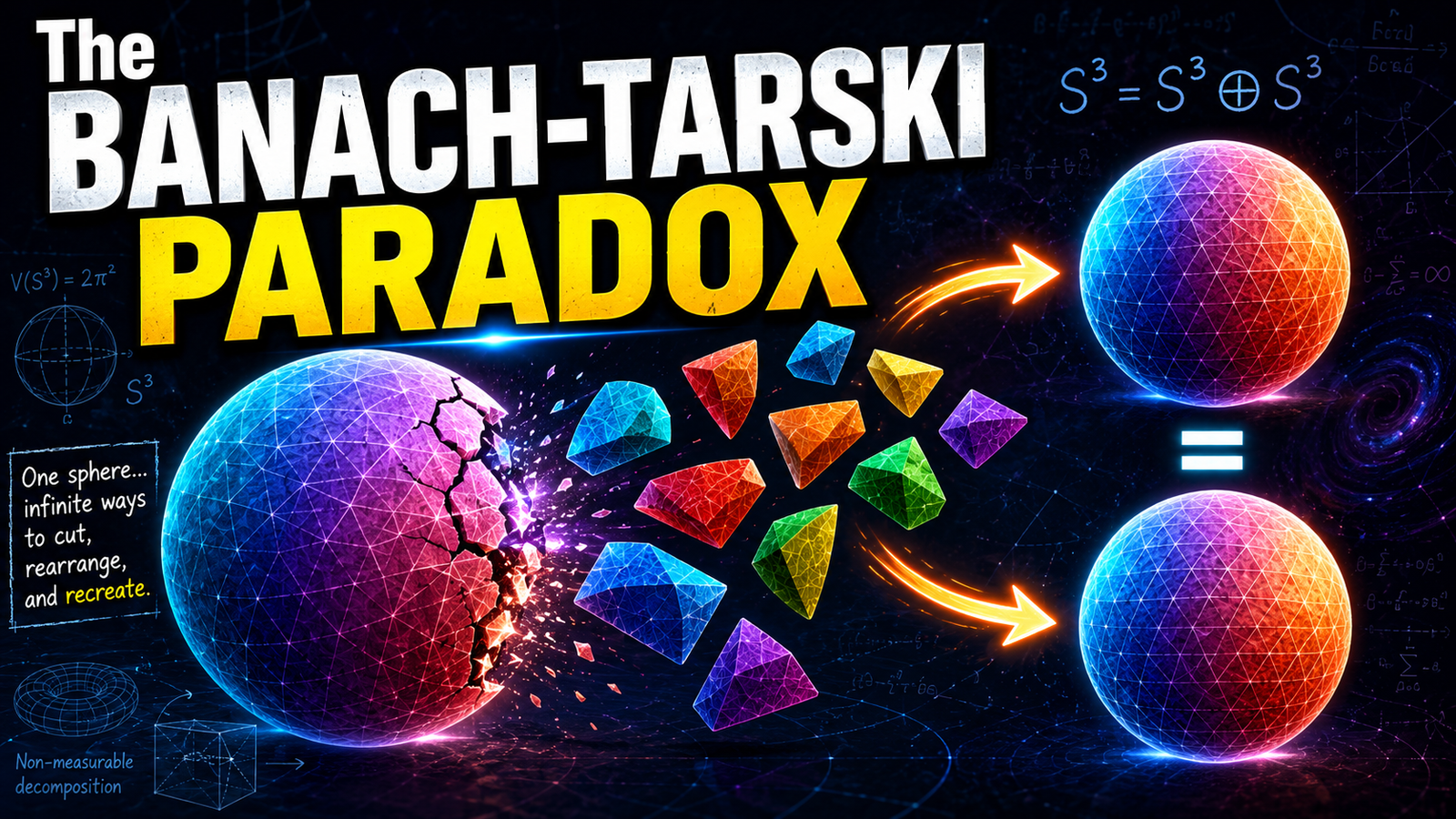
This remarkable property helps in dividing one solid ball into two balls identical in size to the original. At first, the idea may seem impossible and a violation of the conservation of volume, but in 1924, Banach and Tarski proved this using mathematics. It honestly sounds like an illusion of creating a whole ball out of nothing. It is important to understand that it is not practically possible to do the same with a physical ball because a knife cannot make the desired divisions. The five pieces the ball is supposed to be cut into are non-measurable, and the ball contains an infinite number of mathematical points arranged in a highly complicated structure.
How is it possible for something to be non-measurable? And more importantly, how can something non-measurable be cut into several pieces? Mathematics proves that not everything can be measured, meaning some things are immeasurable. A Vitali set is a set of points that contains certain points between 0 and 1 to which no length can be assigned. The set is therefore non-measurable, proving that not everything has a measurement. Another concept is the Axiom of Choice, which is accepted without proof. It states that one element can be selected from each set in a collection of non-empty sets even when there is no rule for making the selection. It seems rather simple, but many aspects of mathematics depend on it, and this is exactly what gives rise to non-measurable sets and the Banach-Tarski paradox.
The free group is used to achieve the desired outcome. The ball is rotated about two perpendicular axes at the same angle. The cosine of the angle is ⅓. When these rotations are combined with their reverses in non-cancelling sequences, each sequence produces a unique final orientation. This helps organise the sets of points for decomposition. Free group of rotations is essential for the construction of this paradox. In the case of a solid ball, a minimum of five pieces is required, which can be rearranged to form two solid balls identical to the original. These five pieces are sets of points selected using the Axiom of Choice. The sets formed are non-measurable, and hence the five pieces cannot be cut into a physical ball with a knife.
The problem is not in the theory, but in our assumption. Many of us assume that the volume is doubled because another ball is formed, but how can the rearrangement of non-measurable pieces double the volume? Since the five pieces have no defined volume, conservation of volume cannot be violated. The volume of the original ball and of each of the two balls formed is
equal; however, the five pieces do not have a volume. This is the true beauty of mathematics and this seemingly impossible trick.
This paradox actually helped mathematicians better understand the unusual behaviour of infinity. It also showed us that some things will forever be out of our reach in the real world. It also illustrated the difference between theory and actual application. Most of you would probably be wondering why this case is special even though there is so much else that also seems impossible. Well, the answer is that this was actually proven using mathematics and the concept of infinity.
Just remember that duplicating objects is not the outcome of the Banach-Tarski paradox, but understanding infinity is. It is essential to learn from others and explore the unknown. And one of the biggest unknowns in mathematics is infinity. Mathematics can often appear impossible while remaining perfectly logical.